Artistic Influences
Surrealism and the influence of Giorgio de Chirico
The metaphysical atmosphere in the early work of Antonio Berni
During his stay in Paris at the end of the 1920s, Antonio Berni came into contact with some of the most innovative currents of the European avant-garde. Among them, surrealism and the metaphysical painting of Giorgio de Chirico offered the artist a visual repertoire that would profoundly mark his early production.
These influences introduced a particular atmosphere into his painting: silent spaces, enigmatic architectures, and displaced objects that generate a sensation of temporal suspension and estrangement.
Giorgio de Chirico and metaphysical painting
The metaphysical paintings that Giorgio de Chirico created between 1910 and 1918—with their deserted squares, elongated shadows, and unexpected encounters between classical sculptures and modern elements—were rediscovered by the Parisian avant-garde in the 1920s.
For Andre Breton and the surrealist circle, these images represented what they called the marvelous: a dimension where everyday reality shifts and acquires an unsettling and poetic quality.
Although metaphysical painting is characterized by rigorous spatial construction, its capacity to transform ordinary settings into spaces charged with mystery profoundly influenced the artists working in Paris during these years.
Berni and the surrealist language
During his stay in Paris, Berni became linked with intellectual circles close to surrealism. The poet Louis Aragon introduced him to Andre Breton, while the philosopher Henri Lefebvre brought him closer to Marxist thought.
These experiences simultaneously marked his artistic formation and the development of the social concerns that would later define his work.
Berni's brief surrealist period
The paintings created by Berni between the late 1920s and early 1930s constitute a relatively small corpus within his production.
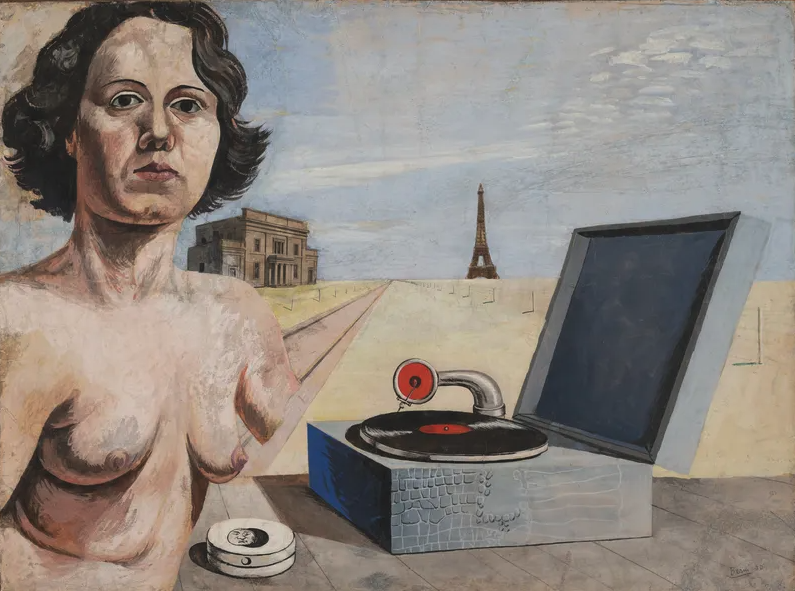
This group includes paintings and collages made during his years in Europe and in the period immediately following his return to Argentina. Among the most representative works of this stage are La Torre Eiffel en la pampa (c. 1930), La siesta y su sueno (1932), La muerte acecha en cada esquina, Landru en el hotel, Paris (1932), and La puerta abierta (1932).
These works reveal Berni's interest in exploring the poetic possibilities of space and in combining recognizable landscapes with unexpected elements that alter the logic of reality.
La playa within this context
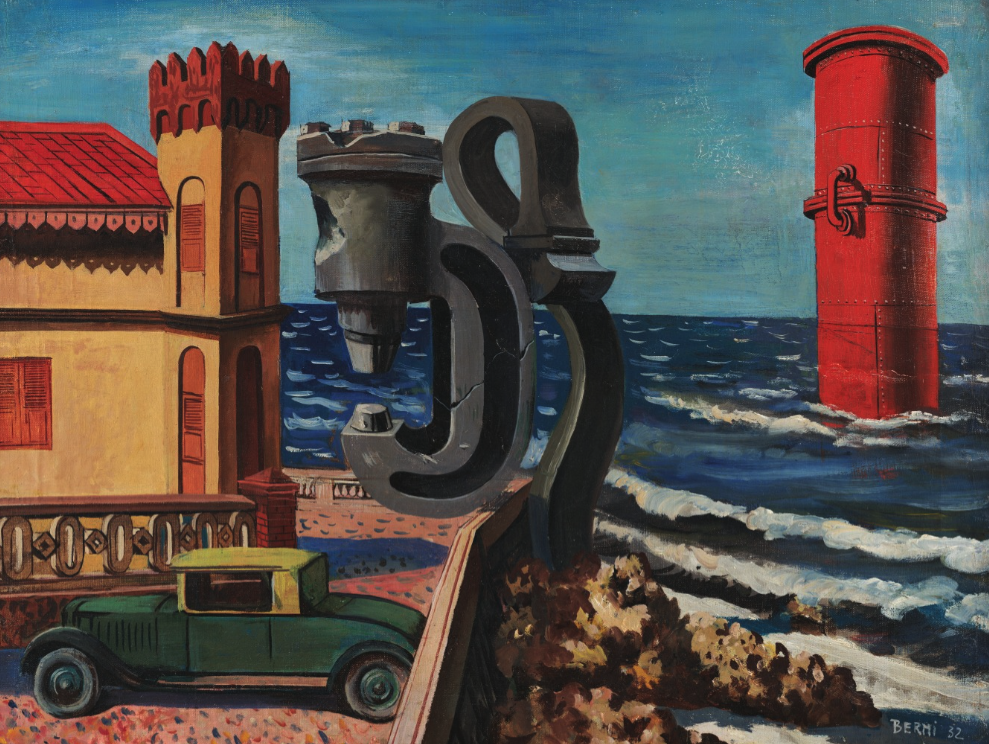
Within this body of work, La playa (1929) occupies a particularly significant place.
The scene presents a coastal landscape stripped of human presence, where architectural structures acquire an almost sculptural dimension within a silent and carefully ordered space. The clarity of space and suspended atmosphere evoke the metaphysical tradition associated with Giorgio de Chirico.
More than a simple representation of landscape, the painting proposes a scene charged with psychological resonances, where architecture and natural environment seem to coexist in silent tension.
From surrealist experimentation to social realism
Berni's surrealist period was relatively brief. After his return to Argentina at the beginning of the 1930s, the artist progressively oriented his work toward a painting deeply committed to social reality.
However, the visual explorations of these years would not disappear entirely. The unsettling atmospheres, the psychological tension of space, and the symbolic dimension of the landscape would reappear transformed in the great social compositions that would mark his later production.
In this sense, Berni's surrealist paintings represent a key moment of experimentation within his career, where the artist assimilated the currents of the European avant-garde before transforming them into his own critical language.
Sources and references
- Andre Breton – Manifesto of Surrealism
- Museo Reina Sofia – Surrealism
- MoMA – Surrealism Collection
- Dawn Ades – Surrealism in Latin America